




"Is Your Brain Secretly a Trauma Detective? Unpacking the Mysteries of Traumatic Intelligence!"
Added on October 25, 2026 inFREE ASTROLOGY
Numerology Meets Netflix: Get Your Daily Dose of Cosmic Cinema Suggestions Powered By Our AI Astrologer. Find The Show Or Movie You Were Meant To See!
Then Join Our FREE Newsletter To Watch Your Choice Of Movies And Shows For FREE Plus Get The Latest Entertainment News And Updates!



In a world where the stars align and our inner complexities spark chatter, the idea of “traumatic intelligence” dances into our consciousness—just like Mercury retrograde messing with our tech! Today, we explore this fascinating but contentious psychological concept, which suggests that growing up in emotionally chaotic environments might sharpen our instincts in unexpected ways. Is it really a cocktail of heightened awareness and paradoxical calm, or just a clever label we’ve assigned to complicate our already tangled psyches? As we unravel this tale filled with personal insights and thoughtful skepticism, we can’t help but wonder: are we really shaped by our traumas, or do our experiences merely add quirky layers to our already distinct selves? Grab a comfy seat, because this one’s a journey through memories, introspection, and perhaps a sprinkle of cosmic wisdom! If you’re intrigued, LEARN MORE.

“I did not want to grow up in scum and villainy, but here I am! Luckily, I had wits, perspective, internal jokes, wishes, hopes and dreams.”
I wrote that today and noticed how the “scum” part falls off, by the time I reach the end of the sentence. I decided it was worth expounding on.
This came up when a reader brought me the concept of “traumatic intelligence”. It was interesting though I don’t think it applies to me.
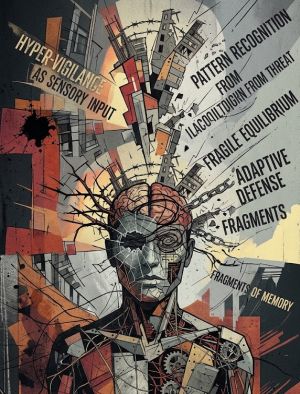
For reference, “traumatic intelligence” it s psychological concept that describes how growing up in unpredictable, emotionally volatile, or unsafe environments reshapes the nervous system into a sharp survival mechanism
Traumatic intelligence said to be where CPTSD and high intelligence meet. I’m skeptical. It’s not that I don’t think this can happen. It’s that I feel this is reductive; simplifying something that is not at all simple. Ultimately, it becomes a way to tag people. “Oh, he or she was traumatized, therefore this person displays these traits…” People are not that simple, by a shot.
I’m willing to us myself as an example to illustrate variance. My traumatic background is well documented. I taught myself to read when I was four years old. That’s intelligence. Now, let’s look at the traits:
I think this is enough, it should give a person pause before applying this label to themselves and others. Personally speaking, I was aware I was in major trouble at home; plotting to leave by the time I was six years old. I was not of the “scum and villainy”, but a girl with, “wits and laughs abs wishes, hopes and dreams”. You think I would let someone take this from me?
What do you think of the idea of “traumatic intelligence”?
Auto Amazon Links: No products found.



















)