





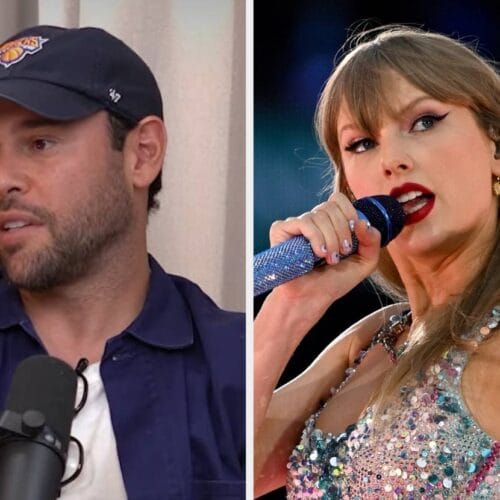


Over the past decade, much has been said (and sung) about Taylor Swift’s “feud” with Scooter Braun. And though it feels like we’ve heard it all, Scooter is continuing to call out the misconceptions.
For a quick reminder, at the time of Taylor’s infamous beef with Kanye West in 2016, Scooter was the rapper’s manager. We don’t exactly know how involved Scooter was in all the Taylor/Kanye drama, but, at the height of the feud, Justin Bieber posted a screenshot from a FaceTime call with Scooter and Kanye to his Instagram page. In this pic, Scooter and Kanye were laughing, and JB captioned it, “Taylor swift what up,” which, if you’re Taylor, probably didn’t feel all that great.

Three years later, in 2019, Taylor’s former manager Scott Borchetta sold his record label, Big Machine Records, to Scooter’s company, Ithaca Holdings, for $300 million. This meant that Scooter would profit from the sales and use of all of the music that Taylor released through Big Machine during her 10-year contract with them, which, as I’m sure you know, included her first six albums.
Given Scooter’s ties to Kanye and that whole situation, Taylor was not pleased about the Big Machine sale. In a lengthy Tumblr post at the time, Taylor said that Scott selling to Scooter was her “worst case scenario,” and went on to claim that Scooter had “stripped” her of her life’s work that she “wasn’t given the opportunity to buy.”
Scooter — who wound up selling Taylor’s entire catalog to Shamrock Holdings for more than $300 million in October 2020 — has said on more than one occasion that when he acquired Big Machine, he assumed that it meant that he’d get to work with all of the artists that the label covered. “I thought it was going to be an exciting thing,” he said on the Diary Of A CEO podcast in 2025.
Instead, Taylor set out on a well-documented mission to rerecord her old music, making the “Taylor’s Version” editions of Fearless, Red, Speak Now, and 1989. While doing so, she very much framed Scooter as her “nemesis” along the way, releasing a whole host of scathing tracks that fans believe are about him.
So, now that all is said and done, and Taylor is the proud owner of her OG masters, once again, Scooter has opened up about being perceived as the bad guy in the story. “[I] went from being like, loved and appreciated for over a decade to literally a villain the next night,” he told Suzy Weiss during a recent appearance on her Second Thought podcast, in which he firmly set the record straight on the actual nature of his relationship with Taylor.
“I will say something that will really sum it up that I don’t know if I’ve ever really said: I don’t know Taylor Swift. I think I’ve met her in my life three times. I have never had a substantial conversation with her in my life,” he said. “I, one time, got invited to a private party by her. She told me she had the utmost respect for me. I told her I had the utmost respect for her. You don’t spend $300 million buying a label that she’s on unless you’re excited at the opportunity to work with her. I will never truly understand that situation, to this day. I wish her nothing but the best.”
Scooter said he learned “a tremendous amount” from the experience and chose to “grow from it.” “I’m grateful for it at this point in my life,” he said. “But I think there’s this big misconception that, like, we knew each other, and we had this feud and, like, I managed her for years. And people are usually shocked to find out that I legitimately don’t know her and didn’t have many interactions with her and never really knew her.”
“And like I said,” he continued, “I think I met her three times in my life, and I think I spoke to her really once for like more than two minutes. But it was a very nice conversation. And beyond that, nothing ever. And then the three years prior to us buying Big Machine, she and I had no contact. I think it was two years. The party was like two years earlier or three years earlier, and then we never had any contact through the whole thing. So I’m just as confused that this is part of my life as you are. But I choose to learn and grow from it.”
On another positive note, Scooter said that one of the good things to come out of the situation was how it increased other artists’ awareness about owning their music. “The majority, to this day, of masters are still owned by labels,” he said. “As confusing as [the situation was] to me, I think what it did bring to light is that artists are going to start wanting to own their masters, and I think you’re seeing artists more and more do that, and I think that’s great.”








)