






Forget Julius Caesar — Meet the 8 Ancient Roman Women Who Were the Real Political Powerhouses Behind the Throne!
Added on December 10, 2025 inFun And Facts Cards




Numerology Meets Netflix: Get Your Daily Dose of Cosmic Cinema Suggestions Powered By Our AI Astrologer. Find The Show Or Movie You Were Meant To See!


Ever wonder if the stars had a say in who really ran the Roman Empire? While we often picture those grand marble halls filled with robed emperors, senators, and generals — all men, mind you — there was a shadow cabinet of formidable women quietly juggling power, playing kingmakers, and sometimes, downright running the show. These ladies weren’t just background characters in togas; they were the chess players behind the throne in an empire famously built by men, for men. Whether it was clever counsel, ruthless strategy, or sheer will, they steered the fate of Rome with a potency that still commands awe.
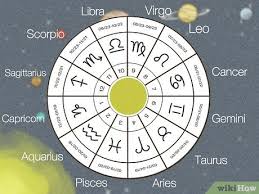
On a day when the moon dances through Scorpio, stirring secrets and bold moves, it feels only fitting to shine a spotlight on eight ancient Roman women who packed a serious political punch. From whispered intrigues to open power plays, their stories pulse with the intrigue of epic dramas — with just a pinch of celestial alignment, of course. Curious how Venus’s charm and Mars’s fire might have mingled with Livia’s cunning or Theodora’s stage-to-throne saga? Well, let’s dive in and unravel how these influential women wielded their sway behind the scenes… or right in the spotlight.
Roman history often brings to mind a parade of emperors, senators, and generals, all men shaping the destiny of an empire. But behind the togas and titles, a group of determined women was influencing policy, managing successions, and sometimes, running the whole show. They operated in a world built by men, for men, yet they found ways to steer the course of history.
These women were not just wives and mothers; they were strategists, regents, and power brokers who left an indelible mark on the Roman world. Here are eight women in ancient Rome who had quite a hefty political weight.

Image Credit: Unknown artist – English Wikipedia, original upload 4 June 2004 by ChrisO – CC BY-SA 3.0/Wiki Commons.
As the wife of Emperor Augustus for over five decades, Livia Drusilla was the definition of a political partner. She presented the image of a perfect Roman matron, dedicated and modest, but her influence ran deep within the imperial court. Augustus frequently sought her counsel on matters of state, and her patronage was a powerful tool for advancing her allies and family.
Historical accounts are filled with whispers that she may have had a hand in clearing the path for her son, Tiberius, to succeed Augustus by removing other potential heirs from the picture. Be they rumors or fact, her efforts paid off. The Julio-Claudian dynasty that followed was her direct legacy. Even after Augustus’s death, she remained a formidable presence, continuing to guide state affairs during Tiberius’s reign. She was eventually deified as The Divine Augusta, a testament to her lasting impact.

Image Credit: Anonymous (Rome) – Own work – CC0/Wiki Commons.
Agrippina the Younger, great-granddaughter of Livia, certainly inherited her ancestor’s ambition. Her political maneuvering was bold and direct. After marrying her uncle, Emperor Claudius, she successfully lobbied for him to adopt her son, Nero. Claudius already had an heir, his son, Britannicus, but Agrippina was relentless in promoting Nero.
When Claudius died under suspicious circumstances, it was Nero, not Britannicus, who ascended to the throne, thanks to his mother’s machinations. For the initial years of Nero’s reign, Agrippina was the true force behind the throne, guiding his decisions and managing the empire. However, as Nero grew older, he began to resent her control. Their relationship soured dramatically, and he ultimately ordered her assassination.

Image Credit: Daderot – Public Domain/Wiki Commons.
Julia Domna was the wife of Emperor Septimius Severus, who came to power after a chaotic period known as the Year of the Five Emperors. She was far more than an empress; she was a partner in consolidating his rule. Julia traveled with her husband on military campaigns, earning the honorary title Mater Castrorum, or “Mother of the Camp.”
Her image appeared on coins, a clear sign of her public status. After her husband’s death, she found herself in the difficult position of mediating between her two sons, Caracalla and Geta, who were meant to rule jointly but despised each other. The partnership ended when Caracalla had Geta murdered. Though their relationship was strained, she continued to advise Caracalla until he was assassinated, after which she took her own life.

Image Credit: Dosseman – Own work – CC BY-SA 4.0/Wiki Commons.
Julia Soaemias, the niece of Julia Domna, was at the center of a plot to restore her family to power. After the death of Caracalla, the praetorian prefect Macrinus became emperor. From their home in Syria, Julia Soaemias orchestrated a rebellion. She and her mother used their wealth and influence to champion Soaemias’s young son, Elagabalus, as the rightful emperor.
The plot succeeded, and the 14-year-old Elagabalus was placed on the throne with his mother acting as the real authority. Julia Soaemias became the first woman ever permitted to enter the Senate. However, Elagabalus’s eccentric behavior, which included religious scandals and disregard for Roman tradition, quickly made him unpopular. The Praetorian Guard, who had helped bring him to power, eventually turned on him, executing both the young emperor and his mother.

Image Credit: Julia Maesa (impératrice romaine) – Bibliothèque nationale de France – Public Domain/Wiki Commons.
The grandmother of one emperor and the architect of another’s rise, Julia Maesa was a political survivor. She was the driving force behind the plot that put her grandson, Elagabalus, in power. But when she saw how Elagabalus’s behavior was threatening the stability of their dynasty, she pivoted. Maesa began grooming her other grandson, Alexander Severus, the son of her other daughter, Julia Mamaea.
She convinced Elagabalus to adopt Alexander as his heir and grant him public honors, effectively setting up a replacement. When the inevitable rebellion against Elagabalus occurred, Alexander was ready to step in. After her death, the grateful new emperor had his grandmother deified.

Image Credit: José Luiz Bernardes Ribeiro – CC BY-SA 4.0/Wiki Commons.
Julia Mamaea was the last of the powerful Severan women. When her son, Alexander Severus, became emperor at just 14 years old, she stepped in as his regent and governed the empire. Unlike her sister Soaemias, Mamaea cultivated a reputation for traditional Roman values while capably managing the state. She reversed many of Elagabalus’s controversial policies and brought a period of stability.
Even when Alexander came of age, he continued to rely heavily on her guidance, officially naming her as his imperial consort. Her influence was so complete that she reportedly had Alexander’s first wife exiled, viewing her as a rival. Their shared rule came to a violent end during a military campaign, when discontented soldiers mutinied and killed them both.

Image Credit: Classical Numismatic Group – CC BY-SA 2.0/Wiki Commons.
Ulpia Severina’s story is a fascinating historical puzzle. She was the wife of Emperor Aurelian, who is credited with reunifying the empire after the Crisis of the Third Century. Aurelian’s rule was transformative but brief, ending with his assassination. Historical sources suggest there was an unusual gap between his death and the naming of his successor.
During this interregnum, it is possible that Ulpia Severina ruled the Roman Empire in her own right. The evidence comes from coins minted with her image that appear to date from after her husband’s death. This suggests she may have held imperial authority, possibly managing the transition of power. What happened to her afterward remains unknown, but for a short time, she may have been the sole ruler of Rome.

Image Credit: Petar Milošević – CC BY-SA 2.0/Wiki Commons.
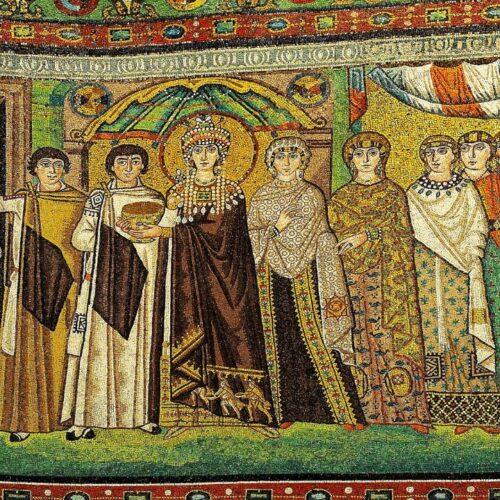
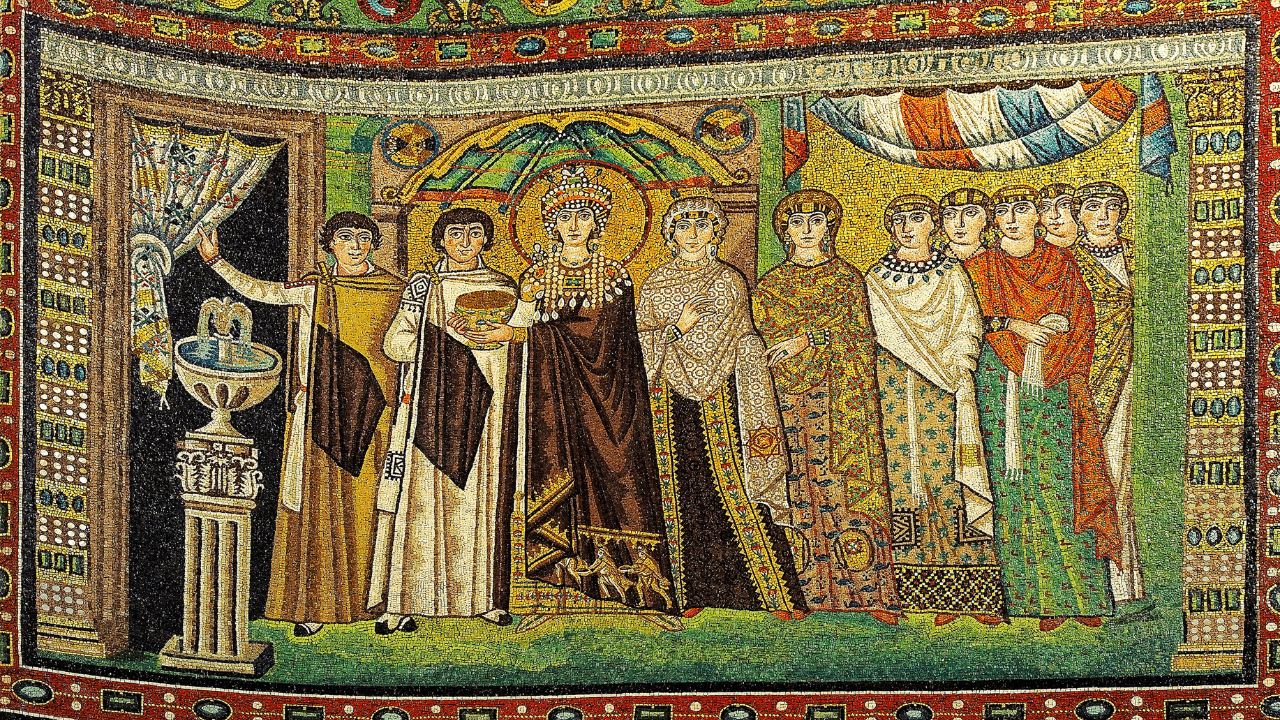
Theodora’s journey to the throne was anything but conventional. Born into a lower-class family, with a father who was a bear trainer and a mother who was an actress, she started her career on the stage and was rumored to have worked as a prostitute. Her life changed when she met Justinian, the heir to the throne of the Eastern Roman Empire. He was so captivated that he changed the law to marry her.
As empress, Theodora became a powerful force at court. Her most famous moment came during the Nika riots, when Justinian was ready to flee the capital. Theodora refused, delivering a powerful speech that convinced him to stay and fight, ultimately saving his throne. She was a true partner in his rule, influencing legal reforms that improved the rights of women and promoting her own allies to positions of power.

Image Credit: G. Ferrero, The Women of the Caesars, New York, 1911 – Public Domain/Wiki Commons.
The stories of these women show that power has always found a way to express itself, even when official channels are closed. They used their intelligence, relationships, and sheer force of will to shape one of history’s greatest empires. Their careers remind us that a person’s influence is not always measured by their title.
Sometimes, the most powerful person in the room is the one who isn’t officially on the roster but is quietly directing the play. Recognizing their contributions gives us a fuller, more accurate picture of the past and a better appreciation for the many ways leadership can emerge.
I’m a Language and Literary Studies (Honors) graduate with 11 years of experience in magazine and blog writing and content creation. I’m passionate about storytelling for change and believe in the power of words to make a difference. My writing is thought-provoking, accessible, and engaging, focusing on the Psychology of human behavior, complex social issues, personal experiences, and the latest trends. I’m a wife and a Mom of three.
I’m a Language and Literary Studies (Honors) graduate with 11 years of experience in magazine and blog writing and content creation. I’m passionate about storytelling for change and believe in the power of words to make a difference. My writing is thought-provoking, accessible, and engaging, focusing on the Psychology of human behavior, complex social issues, personal experiences, and the latest trends. I’m a wife and a Mom of three.
Auto Amazon Links: No products found.












This will close in 0 seconds

This will close in 0 seconds











)