




12 Battles So Wild, Even the Stars Didn’t See These History-Shattering Plot Twists Coming!
Added on December 3, 2025 inFun And Facts Cards




Numerology Meets Netflix: Get Your Daily Dose of Cosmic Cinema Suggestions Powered By Our AI Astrologer. Find The Show Or Movie You Were Meant To See!

Ever wonder how just one day of chaos could spin the world on a whole new axis? I mean, if the planets can mess with our moods in minutes, imagine what a historic battle can do to the fate of entire civilizations! Today, as Mars strides boldly through Aries, stirring up bold moves and fiery clashes, it feels only right to dive into some of history’s most game-changing battles. These aren’t just tales of who won or lost — they’re epic turning points that rerouted empires, reshaped borders, and even left traces in the languages we mumble every day. Ready to see how a bunch of dust and swords echoed across millennia? Hold tight for 12 battles that didn’t just change history — they rewrote it. LEARN MORE.
History books are filled with stories of conflicts, big and small. While every conflict has its consequences, a few stand out for completely altering the world’s trajectory.
Some battles aren’t stories of victory or defeat; they are pivotal moments that rerouted the course of civilizations, shaped empires, and defined the cultural and political landscapes we live in today. They show how a single day of fighting can echo for thousands of years, influencing everything from language to borders.
These are the 12 battles whose outcomes sent ripples across time, forever changing history as we know it.

Image Credit: Unknown Chinese artist – Public Domain/Wiki Commons.
The Battle of Muye marked the peak of the conflict between the long-ruling Shang Dynasty and the rising Zhou state. King Wu of Zhou led his forces against the larger but unpopular Shang army, commanded by Emperor Di Xin. Known for his corruption and cruelty, the emperor had caused widespread discontent. During the battle, many demoralized Shang soldiers defected to the Zhou.
This betrayal sealed the Shang Dynasty’s fate, leading to a decisive Zhou victory. The battle was more than a power swap; it established the longest-reigning dynasty in Chinese history. The Zhou also introduced the “Mandate of Heaven,” the idea that a ruler’s right to govern depended on their virtue. If a ruler became corrupt, Heaven could withdraw its support, justifying rebellion and a new dynasty.

Image Credit: Edmund OllierPublication date 1882 – Cassell’s illustrated universal history – Public Domain/Wiki Commons.
When the Persian Empire, led by King Darius I, targeted Greece, few expected Athens to stand a chance. The Persian army landed at Marathon, anticipating an easy victory. Despite being outnumbered, the Athenians used brilliant tactics, stretching their line to strengthen the flanks and charging the Persians. This maneuver overwhelmed the invaders, forcing a chaotic retreat to their ships.
The victory at Marathon was a major morale boost for the Greeks, proving the seemingly invincible Persian army could be defeated. It united the Greek city-states and fueled their resistance to future invasions. The battle preserved Athenian independence, allowing democracy, philosophy, and theater to flourish.

Image Credit: John Steeple Davis – The story of the greatest nations, from the dawn of history to the twentieth century (published in 1900) – Public Domain/Wiki Commons.
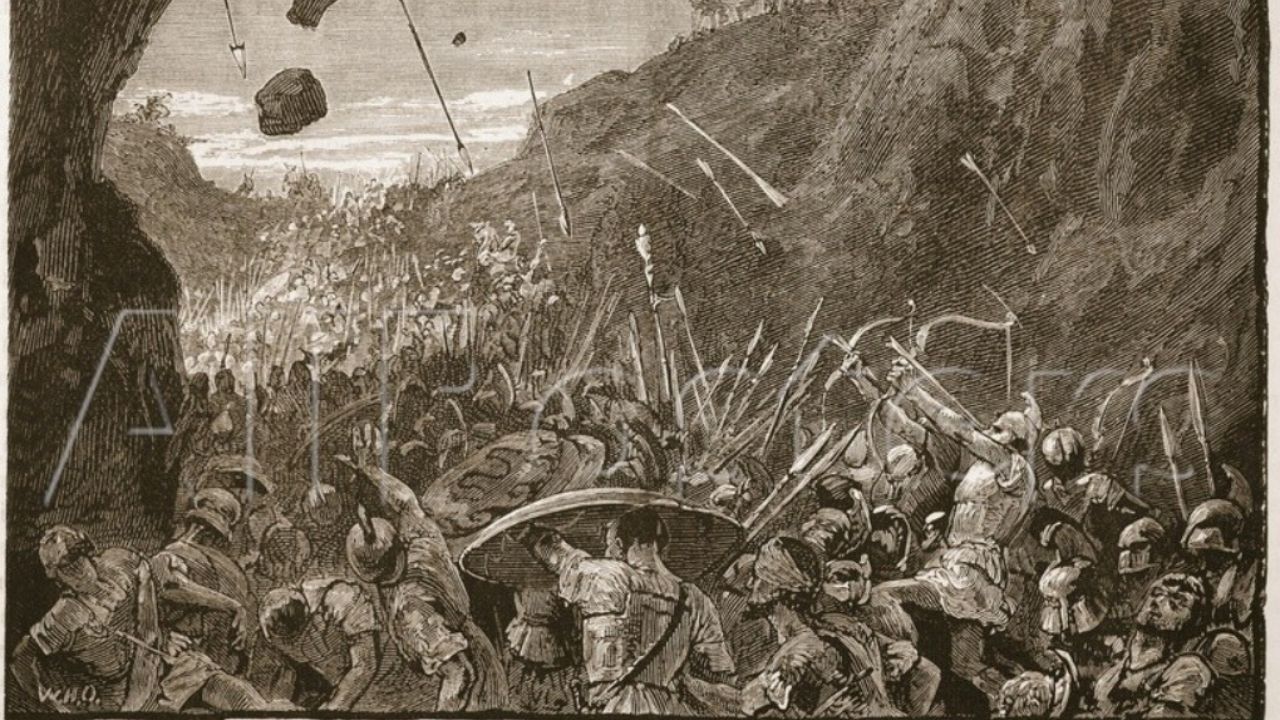
The Battle of Thermopylae in 480 BC was a dramatic clash between Greece and Persia. A small Greek force, including 300 Spartans led by King Leonidas, defended a narrow mountain pass. King Xerxes commanded a massive Persian army, but the Greeks used the terrain to their advantage. For three days, they held the line and inflicted heavy losses. Eventually, a local betrayed them by revealing a hidden path, allowing the Persians to flank and overwhelm the defenders.
Although the Greeks were defeated, Thermopylae became a powerful symbol of unity and resistance. The sacrifice of Leonidas and his men inspired later victories. Most importantly, their stand bought Athens time to prepare its navy. This led directly to the Battle of Salamis, where the Greek fleet crushed the Persians and saved Greece from conquest.

Image Credit: Own work – Public Domain/Wiki Commons.
The Battle of Gaugamela in 331 BC was the decisive showdown between Alexander the Great and Persian King Darius III. On a vast plain, Darius deployed a massive army with scythed chariots, but Alexander outmaneuvered him by baiting the cavalry, exploiting a gap in the Persian line, and leading a charge that forced Darius to flee, throwing his forces into chaos.
This victory ended the Achaemenid Persian Empire. With Persia subdued, Alexander expanded his empire and ushered in the Hellenistic period, spreading Greek culture, language, and ideas across the Middle East and Asia. Blended with local traditions, these influences created a lasting hybrid civilization.
The Battle of Zama in 202 BC was the decisive clash of the Second Punic War. After years of Hannibal’s campaigns in Italy, Roman general Scipio Africanus forced him back to North Africa and used clever tactics to defeat his army and war elephants.
Carthage’s defeat ended the war, stripping it of territories, dismantling its military, and imposing heavy reparations. With its rival subdued, Rome secured dominance over the western Mediterranean and set the stage for the vast empire that would shape the region for centuries.

Image Credit: Charles de Steuben – Unknown source – Public Domain/Wiki Commons.
The Battle of Tours in 732 was a key moment in European history. A large Umayyad force clashed with Charles Martel’s Frankish army, whose disciplined infantry held firm against repeated cavalry charges. When the Umayyad commander was killed, his troops retreated in disarray.
Though it stopped a raid rather than a full invasion, the victory halted Muslim expansion into Western Europe and strengthened Martel’s authority. It also laid the foundation for the Carolingian dynasty, culminating in Charlemagne’s creation of the Holy Roman Empire, a dominant medieval power.

Image Credit: Shutterstock.
The Battle of Hastings in 1066 decided England’s fate after King Edward the Confessor’s death. Harold Godwinson, newly crowned, defeated a Norwegian invasion in the north but then rushed south to confront William of Normandy. Exhausted, his army broke when Harold was killed, ending English resistance.
William’s victory was absolute. Crowned on Christmas Day, he began the Norman Conquest, replacing Anglo-Saxon nobility with Norman aristocracy. English society transformed its language, absorbing thousands of French words, and its political ties shifted from Scandinavia toward continental Europe, a legacy that endures today.

Image Credit: Anonymous – This file comes from Gallica Digital Library and is available under the digital ID btv1b105380390/f117 – Public Domain/Wiki Commons.
During the Hundred Years’ War, England had gained the upper hand, occupying large parts of France and besieging the key city of Orléans. A French defeat seemed certain, threatening to collapse French resistance. At this critical moment, Joan of Arc, a teenage peasant claiming divine visions, arrived at the French court and was given command of the army.
Her presence energized the demoralized French troops. Inspired by her leadership, they launched bold attacks and broke the siege in just nine days. This victory shattered England’s aura of invincibility and revived French national identity. The momentum from Orléans led to further victories and the crowning of Charles VII, securing France’s future as an independent nation.

Image Credit: Jan Damel – image taken by User:Mathiasrex Maciej Szczepańczyk – Public Domain/Wiki Commons.
The Battle of Vienna in 1683 was a key turning point in European history. A massive Ottoman army besieged Vienna, threatening Central Europe. The city was near collapse when a coalition led by Polish King John III Sobieski arrived to save it. The battle’s climax came with Sobieski’s legendary cavalry charge, one of history’s largest, which shattered the Ottoman lines and forced their retreat.
This victory ended Ottoman expansion into Europe and marked the start of the empire’s decline. For the Habsburgs, it secured control of Central Europe and paved the way for their rise as a major power. The battle also highlighted growing European cooperation, foreshadowing future alliances shaping the continent.

Image Credit: Auguste Couder – Château de Versailles – Public Domain/Wiki Commons.
The Battle of Yorktown in 1781 was the decisive moment of the American Revolutionary War. General Cornwallis had fortified Yorktown, awaiting support from the Royal Navy. George Washington, working with French troops, marched south to trap him by land. At the same time, a French fleet defeated the British navy at the Battle of the Chesapeake, cutting off escape and supplies by sea.
Surrounded and outnumbered, Cornwallis was forced to surrender his entire army. The defeat shattered Britain’s will to continue the war. It led directly to peace talks and the Treaty of Paris in 1783, which recognized the independence of the United States.

Image Credit: William Sadler – Napoleon – Public Domain/Wiki Commons.
The Battle of Waterloo in 1815 was Napoleon Bonaparte’s final defeat. After escaping exile, he raised a French army to restore his empire. The Seventh Coalition, led by the Duke of Wellington, met him near the village of Waterloo in Belgium. The fighting was fierce and bloody. Wellington’s troops held against repeated French attacks but were close to breaking. Late in the day, Prussian forces under Gebhard von Blücher arrived and struck Napoleon’s flank.
The French army collapsed, and Napoleon fled the battlefield. His defeat ended two decades of near‑constant European warfare. He was exiled to the remote island of St. Helena, where he lived until his death. Waterloo ushered in the Pax Britannica, a long period of relative peace, and reshaped Europe’s political map for the next century.

Image Credit: Currier and Ives – This file was donated to Wikimedia Commons as part of a project by the Metropolitan Museum of Art – CC0/Wiki Commons.
The Battle of Gettysburg in July 1863 was the largest and bloodiest clash of the American Civil War. Confederate General Robert E. Lee invaded the North, hoping for a decisive victory. His Army of Northern Virginia met the Union’s Army of the Potomac near the town of Gettysburg, Pennsylvania. For three days, the fighting raged with heavy losses on both sides.
The battle ended with Pickett’s Charge, a failed frontal assault on the Union center that caused massive Confederate casualties. Lee retreated to Virginia, his army shattered. Gettysburg is seen as the turning point of the war. It ended Lee’s hopes of invading the North and put the Confederacy on the defensive. The Union’s victory boosted morale and, together with the fall of Vicksburg the next day, paved the way for the eventual defeat of the Confederacy.

Image Credit: Hendrik Scheffer – Heritage Auctions – Public Domain/Wiki Commons.
History isn’t just a collection of facts for trivia night. The world changes when leaders make a bold move, the weather gets dramatic, or reinforcements show up late (face palm). The outcomes of these battles remind us that things could have turned out very differently with just one twist. When those moments shift, countries, cultures, and everyday routines shift right along with them.
By digging into these famous clashes, we get a clearer sense of how unpredictable and fascinating the story of our world can be. If this list inspires some new curiosity, don’t be surprised, your next history rabbit hole could be just around the corner.
I’m a Language and Literary Studies (Honors) graduate with 11 years of experience in magazine and blog writing and content creation. I’m passionate about storytelling for change and believe in the power of words to make a difference. My writing is thought-provoking, accessible, and engaging, focusing on the Psychology of human behavior, complex social issues, personal experiences, and the latest trends. I’m a wife and a Mom of three.
I’m a Language and Literary Studies (Honors) graduate with 11 years of experience in magazine and blog writing and content creation. I’m passionate about storytelling for change and believe in the power of words to make a difference. My writing is thought-provoking, accessible, and engaging, focusing on the Psychology of human behavior, complex social issues, personal experiences, and the latest trends. I’m a wife and a Mom of three.
Auto Amazon Links: No products found.













This will close in 0 seconds

This will close in 0 seconds












)