



8 Ancient Cultures Who Were Basically the OG Stargazers—How Did They Outsmart Our Tech?
Added on November 30, 2025 inFun And Facts Cards




Numerology Meets Netflix: Get Your Daily Dose of Cosmic Cinema Suggestions Powered By Our AI Astrologer. Find The Show Or Movie You Were Meant To See!

Ever wonder how people navigated the skies before the era of flashy stargazing apps and department store telescopes? Well, pull up a chair, because ancient civilizations were not just stargazing for fun—they were straight-up celestial masterminds. Imagine tracking the flood of the Nile by watching a star pop up just before dawn, or predicting eclipses with the kind of precision that’d make your smartphone jealous—all without Wi-Fi or a single gadget. These folks turned the night sky into their personal GPS, calendar, and cosmic to-do list, weaving astronomy into everything from farming to worship to epic monument-building. Intrigued? Let’s dive into eight ancient cultures that had the night sky on lockdown, armed with nothing but sharp eyes, sharp minds, and knowledge passed down through generations. Ready to get starstruck by history? LEARN MORE.
Long before anyone could download a stargazing app or buy a telescope from a department store, ancient cultures were already looking up. And they were doing more than just admiring the view. Without the benefit of modern technology, these civilizations developed remarkably sophisticated systems to understand the cosmos. They used the sun, moon, and stars to create calendars, guide agricultural practices, navigate vast oceans, and build monumental structures aligned with celestial events. This was not a casual hobby; for them, astronomy was a practical science woven into the fabric of daily life, religion, and survival.
Here are eight ancient cultures that managed to chart the heavens with a precision that can still impress us today, using nothing more than sharp eyes, clever mathematics, and generations of accumulated knowledge.

Image Credit: Deposit Photos.
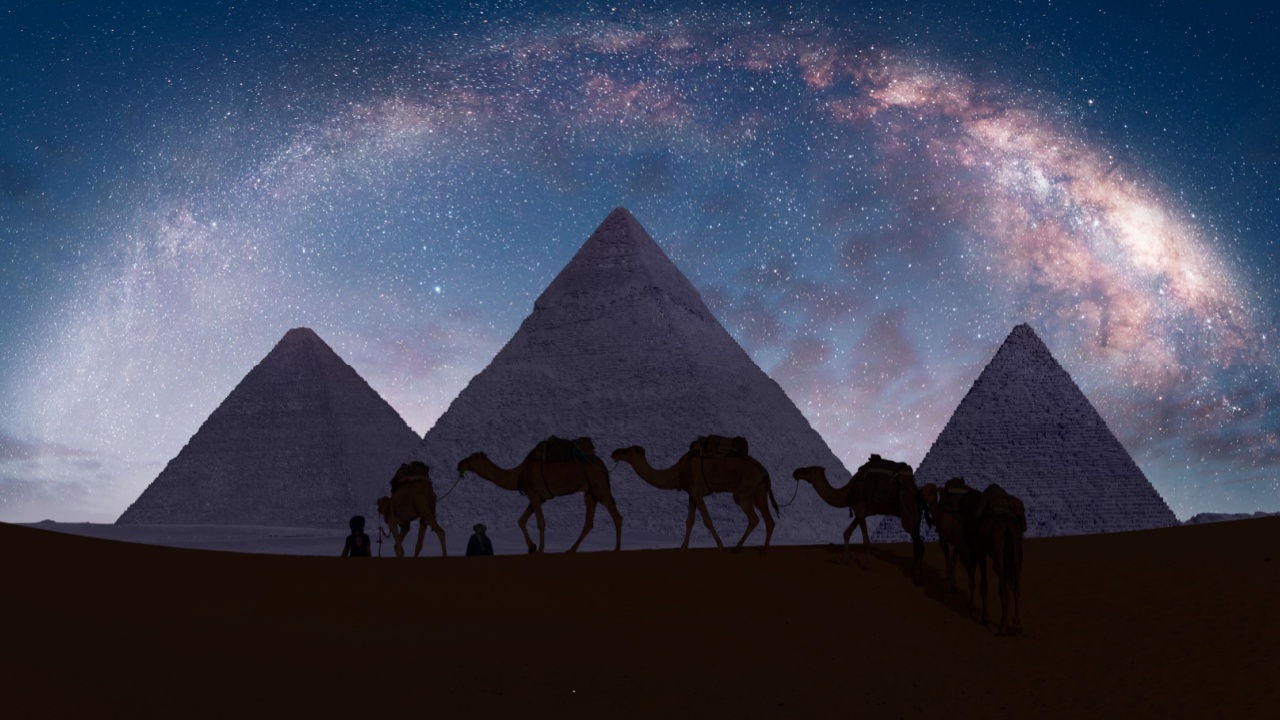
The ancient Egyptians, the civilization behind the pyramids and a writing system I still can’t decipher, were deeply obsessed with the sky. Their farming schedule relied on the annual flooding of the Nile, which conveniently lined up with the heliacal rising of the star Sirius. The moment Sirius appeared over the horizon just before sunrise, they knew the new year had begun, and the floodwaters were coming.
This celestial event was so reliable that it formed the basis of their entire 365-day calendar. Their architectural achievements also reflect this celestial focus. Many temples and pyramids were carefully aligned with astronomical phenomena. The Great Pyramid of Giza, for instance, is aligned with remarkable accuracy to the four cardinal directions.

Image Credit: Deposit Photos.
In the jungles of Mesoamerica, the Maya developed one of the most advanced astronomical traditions of the ancient world. They were meticulous observers, tracking the movements of the sun, moon, and planets with impressive accuracy. Venus was particularly important to them; they charted its cycle with such precision that their calculations were off by only a tiny fraction of a day over hundreds of years.
Their astronomical knowledge is preserved in texts like the Dresden Codex, which contains detailed tables for predicting eclipses and the positions of celestial bodies. Their cities were dotted with observatories, like the Caracol at Chichén Itzá, which were specifically designed to track celestial events and align with solstices and equinoxes.

Image Credit: Deposit Photos.
The Babylonians, situated in ancient Mesopotamia, were among the earliest cultures to apply mathematics to their astronomical observations. They kept systematic, detailed records of celestial events on clay tablets, some of which date back nearly 3,000 years. These diaries chronicled the movements of the moon and planets, the occurrences of eclipses, and other phenomena.
This wealth of data allowed them to spot patterns and develop predictive models. They created tables that could forecast the positions of celestial bodies for years into the future. Their work laid some of the groundwork for the zodiac, dividing the sky into 12 sections to track the sun’s path. This systematic approach and their mathematical methods had a profound influence on later Greek astronomers and, through them, the development of Western astronomy.

Image Credit: Deposit Photos.
For millennia, Chinese astronomers methodically scanned the skies, compiling some of the most continuous and detailed astronomical records in history. Their work was driven by the belief that the heavens were a reflection of the earthly realm and that celestial events could signal fortunes for the emperor and the state. This made astronomy a serious government affair.
They meticulously recorded unusual events, including comets, meteor showers, and what they called “guest stars.” Their ancient descriptions of a guest star appearing in 1054 CE correspond perfectly with the Crab Nebula, the remnant of a supernova. This record has been invaluable to modern astronomers. Chinese astronomers also produced some of the world’s earliest star catalogues and developed instruments like armillary spheres to measure the positions of celestial objects. Their long-term records allowed them to calculate the length of the year with high precision and to predict eclipses.

Image Credit: Gts-tg – Own work – CC BY-SA 4.0/Wiki Commons.
The ancient Greeks inherited a great deal of astronomical knowledge from the Babylonians and Egyptians, but they added their own unique contribution: the use of geometry and physical models to explain what they saw. Thinkers like Ptolemy developed complex geocentric models of the universe, with the Earth at the center, that dominated Western thought for over 1,400 years. While the model was ultimately incorrect, the mathematical and observational methods used to support it were highly sophisticated.
Their ingenuity was not just theoretical. The Antikythera Mechanism, an astonishingly complex device recovered from a shipwreck, showcases their mechanical skill. This hand-powered analog computer could predict the positions of the sun, moon, and planets, as well as forecast eclipses and even track the four-year cycle of the Olympic Games. It demonstrates a level of mechanical engineering and astronomical understanding that was not thought possible for the era.

Image Credit: Deposit Photos.
High in the Andes mountains, the Inca civilization practiced a form of astronomy where the sky was intimately linked with their landscape and sacred spaces. Their capital, Cusco, was designed as a celestial map, with lines called ceques radiating from the central temple, the Coricancha. These lines connected hundreds of sacred shrines, or huacas, which in turn aligned with the rising and setting of specific stars and constellations at different times of the year.
The Inca were primarily solar observers. They built pillars on the hills surrounding Cusco to track the sun’s position throughout the year, allowing them to mark solstices and equinoxes and determine the best times for planting and harvesting. At sites like Machu Picchu, carved stones such as the Intihuatana, or “hitching post of the sun,” are believed to have served as solar clocks or ritual instruments for tracking the sun’s path and marking important ceremonial dates.

Image Credit: Barnaby Norris – Own work – CC BY-SA 4.0/Wiki Commons.
Possessing one of the oldest continuous cultures on Earth, Aboriginal Australians have astronomical traditions that stretch back tens of thousands of years. Their knowledge is passed down through oral traditions, stories, and art, forming a practical guide for life. Instead of just connecting the dots to form star constellations, many groups also find shapes in the dark patches of the Milky Way, creating “dark cloud constellations.”
The “Emu in the Sky,” for example, is a famous dark constellation whose position signals the time to collect emu eggs. This knowledge was essential for navigation, seasonal calendars, and timing social and ritual gatherings. Oral traditions contain detailed descriptions of celestial phenomena, including knowledge of eclipses, the phases of the moon, and the variability of certain stars. This ancient wisdom represents a completely different but equally valid way of mapping and understanding the universe.

Image Credit: Deposit Photos.
The vast expanse of the Pacific Ocean was settled by Polynesian navigators who performed incredible feats of long-distance, open-ocean travel. They did this without compasses, sextants, or maps. Their primary tool was an intricate knowledge of the stars. These master sailors memorized a “star compass,” which was a mental map of where specific stars rise and set on the horizon.
By keeping their canoe aligned with a star on its known path, they could maintain a consistent direction. This was supported by a deep understanding of other natural signs: the patterns of ocean swells, the direction of winds, the flight paths of birds, and the color of the water. This holistic system allowed them to locate tiny islands separated by thousands of miles of ocean, an achievement that stands as one of the most impressive examples of practical astronomy in human history.

Image Credit: Deposit Photos.
The next time you look up at the night sky, take a moment to appreciate it through the eyes of these ancient observers. They saw more than just twinkling lights; they saw a clock, a calendar, a map, and a spiritual guide. Their ability to decipher the complex rhythms of the cosmos demonstrates a universal human drive to understand our place in the universe. It proves that with enough patience, ingenuity, and careful observation, the sky can reveal its secrets, no advanced technology required.
I’m a Language and Literary Studies (Honors) graduate with 11 years of experience in magazine and blog writing and content creation. I’m passionate about storytelling for change and believe in the power of words to make a difference. My writing is thought-provoking, accessible, and engaging, focusing on the Psychology of human behavior, complex social issues, personal experiences, and the latest trends. I’m a wife and a Mom of three.
I’m a Language and Literary Studies (Honors) graduate with 11 years of experience in magazine and blog writing and content creation. I’m passionate about storytelling for change and believe in the power of words to make a difference. My writing is thought-provoking, accessible, and engaging, focusing on the Psychology of human behavior, complex social issues, personal experiences, and the latest trends. I’m a wife and a Mom of three.
Auto Amazon Links: No products found.















This will close in 0 seconds

This will close in 0 seconds











)